Chess
Play chess online for free in your browser. Share a link for a 2 player game with a friend, or practise against the computer. Move six kinds of piece to trap the king. No account needed.
Play over time
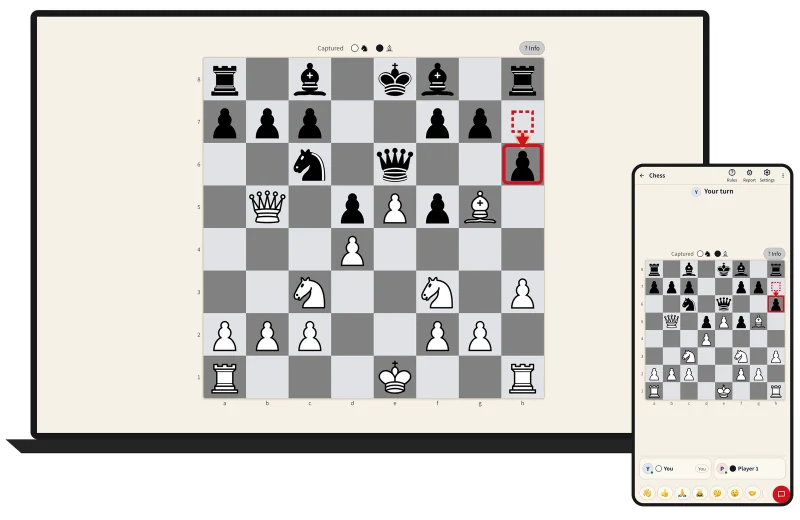
Chess in 30 seconds


- Set upEach player starts with 16 pieces on an 8×8 board. White moves first.
- Take turnsMove one piece per turn. Landing on an enemy piece takes it off the board.
- CheckWhen your king could be taken next move, you are in check and must get out of it.
- WinNo way out of check is checkmate and you lose. No legal move without being in check is a draw.
At a glance
| Item | This game |
|---|---|
| Players | 2 players |
| Play time | About 20 min |
| Type | Board |
| Ranked play | Yes |
| Practice against the CPU | Yes |
| Price | Free (no account needed) |
| Rights holder | A public-domain classic game |
| Last updated | 2026-09-13 |
How to play Chess online with friends
- Tap "Play with friends"A party is created with a 6-character code. No account is needed.
- Send a link or QR codeShare it on LINE, or just read the code aloud.
- Everyone opens it in a browserOnce 2 players have joined, the host taps "Start".
Rule highlights
Setup, play, winning, and house rules
Setup
- Two players. You need an 8×8 board and sixteen pieces each, one set white and one black.
- Fill your two nearest rows: rook, knight, bishop, queen, king, bishop, knight, rook along the back, pawns along the front.
- The queen starts on a square of her own colour. White moves first.
How to play
- Players take turns moving one piece. Moving onto an enemy piece takes it off the board; you may never move onto your own piece.
- A pawn steps one square forward, or two on its very first move, and takes only diagonally forward.
- A knight jumps in an L (two squares then one) and is the only piece that jumps over others. A bishop slides diagonally, a rook along ranks and files, and a queen does both, as far as the way is clear. A king moves one square in any direction.
- If your king and one rook have never moved, the squares between them are empty, and the king is not passing through or landing on an attacked square, you may move both in one turn (castling).
- If an enemy pawn jumps two squares and lands beside your pawn, you may take it diagonally as though it had moved one — but only on your very next turn (en passant).
- A pawn that reaches the far rank becomes a queen, rook, bishop or knight (promotion).
- You may never make a move that leaves your own king able to be taken.
Winning
- A king that could be taken next move is in check, and you must get out of it. If no move does, it is checkmate and the player in check loses.
- If you are not in check but have no legal move at all, it is stalemate and the game is drawn.
- The game is also drawn when the same position appears three times, when fifty moves pass with no capture and no pawn move, or when neither side has enough material to give mate.
- You may give up at any time; giving up loses the game.
House rules
| Name | Description | Default | Changeable |
|---|---|---|---|
| Show legal squares | Mark where the selected piece can go. | On | Yes |
| Swap who starts | Swap who plays white after each game. | On | Yes |
Related features: Board Game History: Games by Date / Shogi Variants and Rule Differences / Chess and Shogi Around the World: Boards and Pieces
Recommendations
Play this game once to write one.
Send feedback or a bug about this game
Request a setting for this game
We publish the feedback you send and what we do about it here
FAQ
How many players?
Two. One plays white, the other black.
How long is a game?
About 20 minutes. There is no time limit.
Is there a clock?
No. Take as long as you like over a move.
Can a game be drawn?
Yes — by stalemate, threefold repetition, the fifty-move rule, or insufficient material.
Whose piece artwork is this?
Colin M.L. Burnett's SVG set, used under the BSD 3-Clause licence.
Can I play at school or work (unblocked)?
Yes. Chess runs entirely in your browser, with nothing to download or install, so it works on most school and work networks that block app stores or game downloads. If your network blocks the whole site, ask an administrator to allow boardgamejoin.com.
Is chess a 2 player game?
Yes. One player moves the white pieces and the other moves black. White goes first, then you take turns.
Can I play on a phone?
Yes. No app is needed — just open it in a browser. You can join the same party as people on a PC or tablet.
Can I play against the computer (CPU)?
Yes. You can play against computer opponents without inviting anyone.
Can I play online with friends far away?
Yes. Start a party and send its invite link. Friends can join in their browsers without signing up.
Is there an app?
This is a free app that runs in your browser. No installation is needed.
Can we play without being online at the same time?
Yes. Choose “Turn-based (told each turn)” and you can make one move whenever you like. We tell you when it is your turn. A Party ends automatically, with no winner or loser, after 45 days without a move.
Rights holder and physical edition
This is a public-domain classic game. The rules follow the standard reference rules.
Related games
Same type (Board)
Same player count
Last updated 2026-09-13 · Run by Qdan, Inc.